Join us for a Biochar Kiln Training Workshop
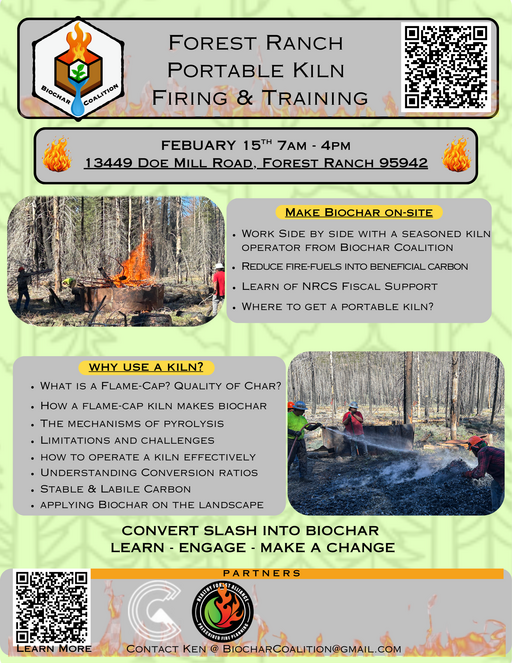
This hands-on training introduces participants to portable flame-cap biochar kilns used for forest and land stewardship. Hosted by the Biochar Coalition, the workshop focuses on converting forest slash and woody residues into beneficial carbon while reducing wildfire fuel loads.
Participants will observe and assist with a live kiln firing, learn safe and effective operating practices, and gain a practical understanding of how biochar can be produced on-site using low-tech, field-ready equipment.
Date: February 15th, Sunday — 2026
Time: 7:00 AM – 4:00 PM
Location: 13449 Doe Mill Road, Forest Ranch, CA 95942
This is a field-based, real-world training intended for landowners, practitioners, restoration workers, and community members interested in applied biochar systems.
 Register hereAdd to google CALENDAR
Learn how a kiln makes biochar
This section breaks down how flame-cap kilns transform woody material into biochar through controlled pyrolysis rather than open burning.
Topics covered include:
- What a flame-cap kiln is and how it differs from pile burning
- How oxygen limitation and heat drive pyrolysis
- Visual indicators of quality char versus ash
- How timing, feedstock size, and loading techniques affect outcomes
- Common mistakes and how to avoid over-oxidation
Participants gain a clear, practical understanding of the mechanisms at work, not just theory, so they can evaluate char quality and operate kilns more effectively in the field.
Learn with your community
Biochar production is most effective when it is community-based, collaborative, and locally adapted. This training emphasizes working side-by-side with experienced kiln operators and fellow participants in a shared learning environment.
You will:
- Engage directly in the firing, monitoring, and quenching process
- Learn from real field experience rather than classroom-only instruction
- Exchange knowledge with land stewards, restoration workers, and neighbors
- Build connections that support future projects and mutual aid
The goal is to strengthen local capacity so communities can safely manage biomass and retain carbon on the land.
Learn why biochar benefits eco-systems
This section connects kiln operation to real ecological outcomes. Biochar is not just a waste product; when properly made and applied, it becomes a long-term asset to soils and landscapes.
Key concepts include:
- Stable versus labile carbon and why it matters
- How biochar improves soil structure, water retention, and nutrient holding
- Interactions between biochar and soil biology
- Applications in post-fire landscapes, forests, gardens, and agricultural soils
- Limitations and responsible use; when biochar is appropriate and when it is not
Participants leave with a grounded understanding of how biochar fits into ecological restoration and land management rather than treating it as a one-size-fits-all solution.